From Courtroom to Community: How a ‘Spider’ Transformed a Water Conflict
Bishnuraj Bhatt and Suryaprakash Khadka are the ward chairpersons of Wards No. 10 and 11 of Amargadhi Municipality in Dadeldhura. Sharing the same political ideology, their victory in the 2017 local elections was celebrated enthusiastically by their supporters.
That happiness, however, did not last long.
Soon after the elections, differences began to surface between the two ward chairs as they attempted to address local issues. Communication gradually broke down. Their supporters also began exchanging verbal abuse, eventually clashing with one another. The two neighboring wards—once closely connected—turned into bitter rivals. As tensions escalated, the conflict reached the point of legal action.
Neither side was willing to compromise. While both appeared ready to accept a legal verdict, neither was prepared for a negotiated settlement.
The root of the conflict was a water source.
Around 1983, a drinking water project was initiated at the Sairoda stream in Raigaun of Ward No. 10. The water source lay along the boundary of Wards No. 10 and 11. Though administratively separate, the two villages had long functioned as a single social unit, connected by water. More than a dozen surrounding settlements also relied on this source, while other villages used different water sources within their own wards.
Around 1983, a drinking water project was initiated at the Sairoda Stream in Raigaun, Ward 10. While the source was technically in Ward 10, it sat on the border of the two wards, and for decades, the two villages functioned as a single community.
As the population grew, the Sairoda source began to dry up, creating water shortages. Community leaders and intellectuals discussed alternatives and eventually agreed that Ward No. 10 would continue using Sairoda, while Ward No. 11 would rely on its traditional source along with water from the Badesim source located in Ward No. 10.
For years, both communities followed this understanding.
Later, funds were allocated through the District Drinking Water and Sanitation Division Office for the repair of drinking water schemes—Rs. 8 million for Ward No. 10 and Rs. 14 million for Ward No. 11—under the Sahastraling Drinking Water Project.
Accordingly, Ward No. 11 planned to connect its old source with the Badesim source to create a new intake. Registration of the source was required. Since Badesim lay within Ward No. 10, discussions were held between the two wards.
Ward No. 10 agreed to allow Ward No. 11 to register and use the Badesim source, with a mutual understanding that neither ward would claim any additional sources without consultation and coordination.
However, during implementation, Ward No. 11 attempted to include another source—Halaudekhola—located 30–35 meters above Badesim, under Scheme No. 8. This source also lay within Ward No. 10.
Ward No. 11 issued a public notice seeking objections regarding the new source. Ward No. 10 objected, stating that there had been no agreement to use Halaudekhola and that Ward No. 11 could not unilaterally claim a source within its territory. Following the objection, construction work was halted.
Meetings of elders and intellectuals from both wards were convened, but neither side was willing to shift its position. Ward No. 10 argued that although Badesim lay within its territory, it had offered the source in good faith, only for Ward No. 11 to begin asserting excessive claims. Ward No. 11, citing its larger population and settlement size, insisted on constructing the source as it saw fit.
As the dispute intensified, verbal abuse escalated into physical confrontations. The social fabric tore apart. Hostility replaced harmony. Social relations collapsed—people stopped attending weddings, funerals, and other cultural rituals in neighboring wards. Drinking water pipelines were cut in retaliation. Ward No. 10 filed a case at the District Administration Office, while Ward No. 11 approached the Judicial Committee of Amargadhi Municipality.
The conflict ultimately turned into a contest of prestige between the two ward offices, led by their respective chairpersons. Regular ward functions were affected.
The District Administration Office ruled that the matter fell under local jurisdiction and referred it back to the municipal Judicial Committee. The committee made extensive efforts—conducting field inspections and holding discussions up to 17 times— but no one budged. Eventually, the committee was compelled to issue a decision.
According to judicial committee member Bhaktabahadur Sahu, the decision allocated 20 millimeters of water from the Halaudekhola source to Sahastraling Secondary School and the Sahastraling Health Post in Ward No. 10, institutions that had long complained of water shortages.
Ward No. 11’s consumers rejected the decision, calling it unilateral, and filed a case at the District Court, Dadeldhura. The court held multiple hearings but eventually referred the matter to a Mediation Center. Despite four rounds of mediation sessions led by mediator Rohit Deuba, no resolution was reached. The court then sent the case back to the municipal Judicial Committee for reconsideration.
With the case bouncing between institutions, the conflict hardened into an issue of ego. Both sides were prepared to accept a court verdict but not the committee’s decision, even considering appeals up to the Supreme Court.
Despite repeated attempts by Mayor Bishweshwar Prasad Ojha, the conflict remained unresolved. “This was the biggest headache of my tenure,” he said. “No dispute of this scale had ever arisen before.”
Deputy Mayor Sangeeta Bhandari, who headed the Judicial Committee, faced intense criticism. “People asked what the committee was doing if it couldn’t resolve conflicts,” she said. “When the court also sent the case back, the pressure and stress were immense.”
Meanwhile, the Rs. 22 million allocated for water system repairs faced the risk of being frozen, and hostility between communities deepened, raising fears of serious violence.
It was at this critical moment that the Natural Resource Conflict Transformation Center–Nepal (NRCTC-N) stepped in.
The organization had previously facilitated several natural resource conflicts in Dadeldhura. After learning about its work, Deputy Mayor Bhandari recommended it to the organization. National Resource Person Tej Bahadur Mahara and team studied the case.
“We were confident we could transform this conflict,” Mahara said. “But it had evolved into something far more complex—an ego-driven conflict between two wards.”
Despite skepticism and resistance, the organization began facilitating dialogue following its multistakeholder conflict transformation process. Initial discussions were heated, with locals questioning how an organization could resolve what even the courts had failed to settle.
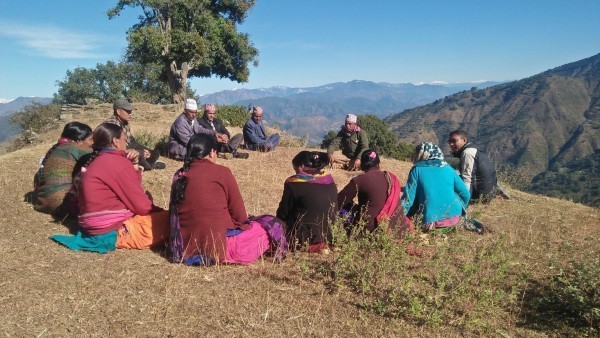 Spider Team Meeting
Gradually, through persistent engagement, trust-building, and dialogue, tensions eased. A “Spider Group”—a flexible, community-based facilitation mechanism—was formed, comprising five members from Ward No. 10 and seven from Ward No. 11. The group received three days of capacity enhancement and leadership handover training.
After numerous challenges and 37 rounds of meetings, a breakthrough was achieved. Both sides voluntarily signed an eight-point joint agreement, committing to shared water use, mutual consultation, and the abandonment of past grievances.
Following the agreement, the stalled budget was reinstated, repair work resumed, and relations between the two wards gradually normalized. Former adversaries began cooperating again.
"We transformed the conflict by ourselves," said Manu Devi Bhatt of Ward 10. "Now, we aren't afraid of each other anymore."
Local leaders, officials, and community members expressed relief and gratitude. What once threatened to permanently divide two communities was transformed into a model of grassroots peacebuilding.
The water conflict that courts could not resolve was finally settled—by the community itself, through the web woven by the “Spider.”