The Nepali proverb we’ve heard since childhood, "Bhannelai fulako mala, sunnelai sunko mala, yo kura sidhai baikuntha jala" (a garland of flowers for the speaker, a garland of gold for the listener, and may these words head straight to heaven), feels just as relevant today as it ever was. It underscores exactly how vital the act of listening is.
Despite this wisdom, a question continues to trouble me wherever I go and in nearly every discussion I attend—do we genuinely listen, or do we merely wait for our turn to speak?
In reality, in today's fast-paced lifestyle, no one seems to have the time to listen to others. In most gatherings, meetings, and discussions, we tend to focus solely on speaking. More often than not, we present our views and leave immediately.
Even those who appear to be listening are often simply waiting for their turn; they are listening "to speak" rather than "to understand". This tendency is particularly prominent among those in positions of power or high social standing. We rarely reach a mindset that is genuinely prepared to listen.
While everyone has taught us how to speak, no one has taught us how to listen. There is a glaring lack of appreciation for the fact that the truth is often uncovered only by listening to others. The prevailing mindset that "only the weak listen, while the strong command" has led to countless instances where discussions fail to reach a meaningful conclusion.
I have participated in various gatherings and meetings across all levels, from high-ranking leadership to the grassroots. In most of them, I have witnessed the same outdated patterns and tendencies. However, a discussion taking place in Gauri Village, Ward No. 5 of Rapti Sonari Rural Municipality in Banke District, truly astonished me.
We often find it difficult to manage even a small gathering of people. Yet in this case, a large number of people had come together to engage in dialogue to transform a boundary conflict over a community forest. For nearly nineteen years, a conflict over boundaries had persisted between the user groups of the Ramkuti Community Forest and the Sunkholi Community Forest.
This conflict, lodged like a thorn in the heart of the village, prompted repeated interventions by the Division Forest Office, the Sub-Division Office, and the local judicial committee in efforts to resolve it. Yet no solution emerged. The village continued to suffer under the status quo, the community grew increasingly disillusioned, and the local leaders eventually became inactive.
In this context, on the recommendation of the judicial committee, the Natural Resource Conflict Transformation Center–Nepal (NRCTC-N) began facilitating the conflict through the spider group. It opened a new door for dialogue by bringing together all stakeholders-one where everyone had a place, was heard, and listened.
The spider group is a team of individuals representing parties involved in a conflict, established to coordinate, facilitate, and lead the conflict transformation process. The group is neutral, impartial, patient, and trustworthy, with a focus on mutual interests.
As part of the procedural multistakeholder conflict transformation process, the spider group convened this joint meeting to discuss common alternatives and reach consensus on the ongoing conflict between the two communities.
Although a large number of people had gathered, the meeting proceeded in a cordial atmosphere. There was no room for shouting or verbal abuse. Equal treatment and opportunities were ensured for everyone, creating an environment where all participants could both listen to one another and express their own views.
The meeting was conducted using the “Khat Method.”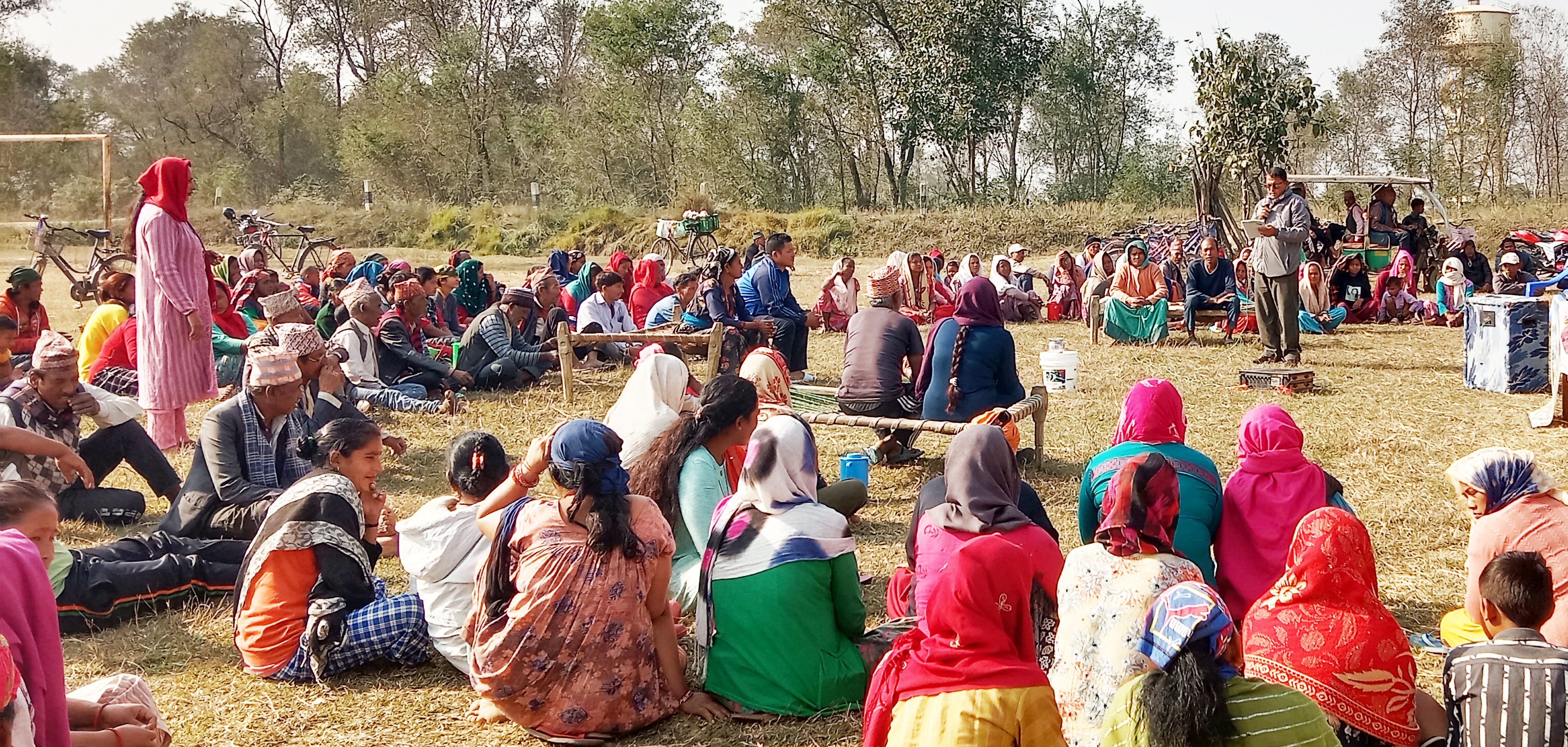
It may sound surprising at first. After all, isn’t a khat (cot) simply a place to sleep? Yet in this context, the khat (cot) became a symbol of decorum, discipline, and equality in dialogue.
Compared to the way large gatherings had been conducted in the past, this method stood out for its distinctiveness and its practice of treating everyone equally. In this joint meeting, a khat (cot) was arranged for each party to the conflict, the concerned stakeholders, and the facilitators alike, placed before everyone.
At the beginning of the meeting, two representatives from each party and stakeholders were seated on the khats as designated speakers. All other members of the respective groups were seated in orderly rows behind them.
The rule governing participation in the discussion was equally striking: "only those seated on the khats were permitted to speak".
During the discussion, if someone seated behind the khat (cot) wished to speak, the person currently seated on the khat would step back, allowing that individual to come forward and speak from the khat (cot). No one was allowed to speak without being seated on the khat (cot).
The community members and stakeholders had been informed about the meeting procedure in advance, which allowed them to arrive mentally prepared.
When managing the meeting, the spider group paid meticulous attention to practical details. A member of the group explained, “When arranging seating in such meetings, we ensure that in the winter months everyone gets sunlight, and in the summer months everyone stays cool. Otherwise, it might appear as if we are showing favoritism”.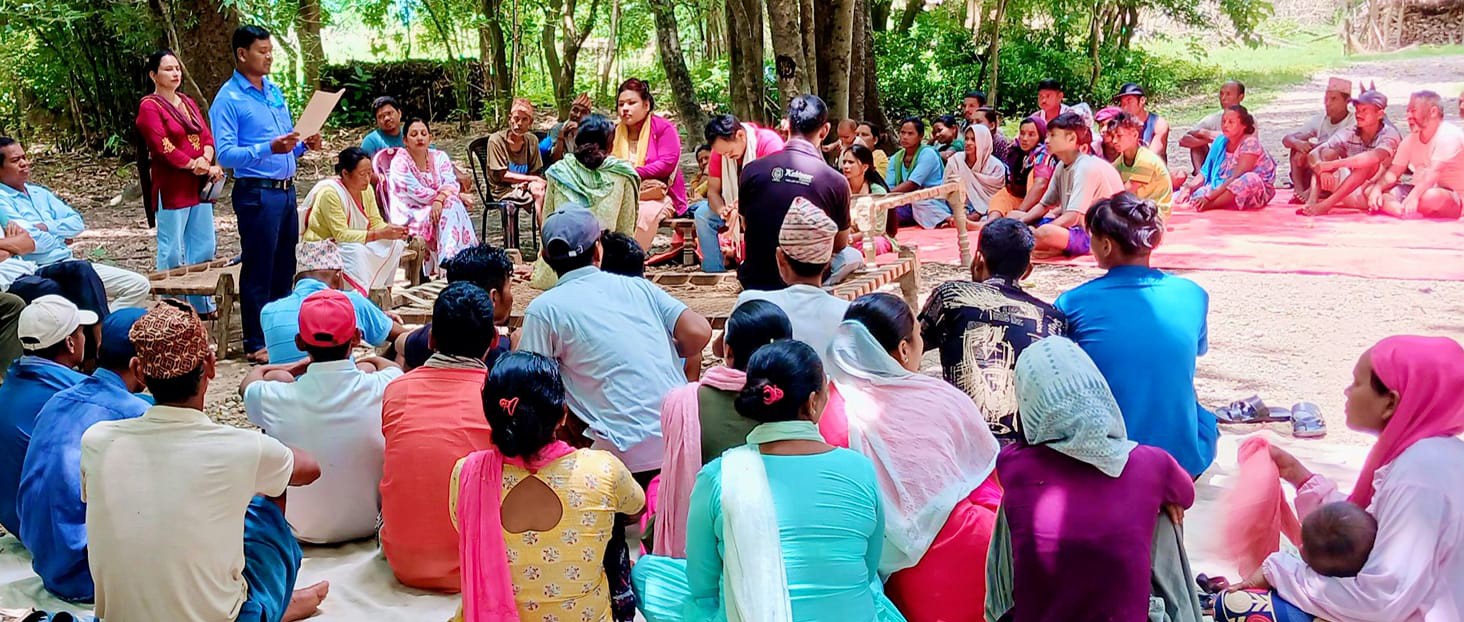
In this discussion, everyone listened to one another. The villagers of Dhampur and Chilhari openly expressed their feelings. Reflecting on the past, local leader Ram Tharu recalls, “Earlier, decisions were made from above and imposed on the community. The villagers did not accept these top-down decisions. Discussions were confined within the four walls of the office.”
He adds, “but the situation is different now. Discussions are held directly with those who are affected by the conflict. The same rules, the same space, and the same opportunities are provided for everyone. This method, which places everyone on an equal footing, has fostered a sense of ‘we are all equal.’ It feels as though this truly forms the foundation of participatory democracy.”
This approach standardized the dialogue, preventing haphazard and unrestrained discourse. Maintaining a structured environment allowed the discussion to lead more efficiently to a final conclusion.
Locals and stakeholders were pleased with the manner in which the meeting was conducted. There was no sense of hierarchy or ego, no one was treated as superior or inferior. The proceedings were free from hostility and disruption; instead, every opinion was met with respect. More critical than resolving a 19 years old conflict was the need to establish a culture of mutual listening, understanding, and dignity; a goal that this process successfully achieved.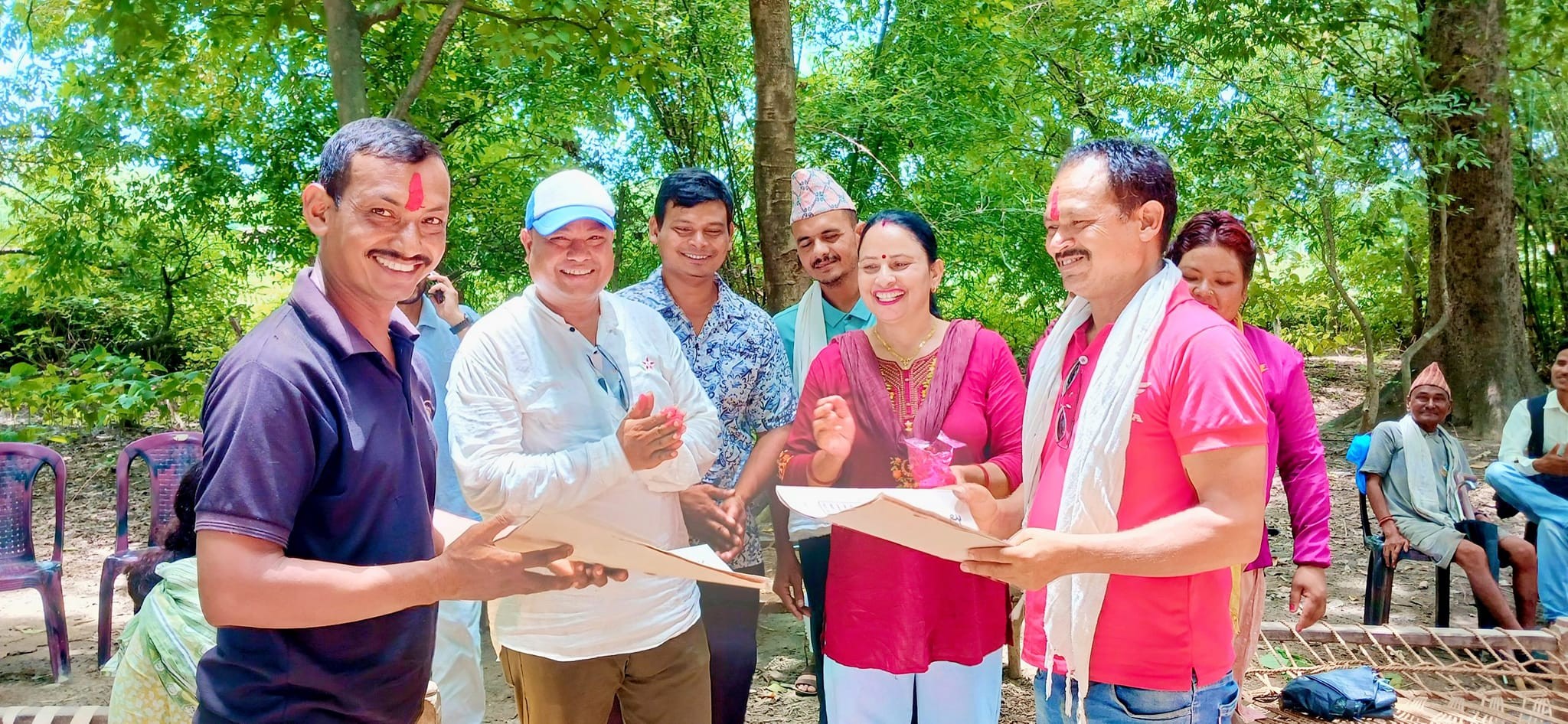
Smiling, Bintiram Tharu says, “Now we have even started listening to ourselves. Earlier, we had the habit of imposing only our own views. Now, we pay attention to, listen to, and understand others as well.”
The joint discussion conducted through the khat (cot) method ultimately resulted in a seven-point agreement.
These agreements were not limited to paper, they were implemented. A decades long conflict was peacefully transformed. Tears of joy and smiles were exchanged. This outcome was made possible not merely by a meeting, but by the right approach and a strong, well-structured process.
No matter how much we emphasize dialogue today, a solution remains out of reach without a culture of listening. The experience in Rapti Sonari teaches us that resolving conflict requires more than just speaking; it demands a mindset willing to take the 'listener’s seat.' From this village, a powerful message has emerged: 'Heard, Understood, and Transformed'.
Ultimately, the 'khat (cot) method' has emerged as a powerful tool for organizing systematic discussions between groups with differing interests. It introduces a fresh etiquette for dialogue. This method is being scaled across the country by the 'Spider Group,' who adapt the setup to whatever is available; be it chairs, stools, or floor mats.
The core of this practice lies not in the physical furniture, but in the discipline of listening and the manner of expression. This approach highlights a vital lesson: solutions become possible only when we value the voices of others. If more organizations and communities were to embrace this spirit, the potential for problem-solving would be limitless.
The Natural Resource Conflict Transformation Center–Nepal (NRCTC) has been facilitating community-level conflicts using the spider web concept. Several natural resources based multistakeholder conflicts have been transformed under the facilitation of spider members. Alongside conflict transformation, relationships among the parties have improved, and activities related to resource management and development have resumed smoothly.
By prioritizing good governance, social justice, and prosperity, the organization has been contributing meaningfully toward achieving the national goal of “Prosperous Nepal, Happy Nepali.”