How a Nine-Month Spider-Web Conflict Transformation Process Helped Rebuild Trust between Two Neighboring Communities in Dolakha, Nepal
For nearly two decades, the people living on either side of a forested ridge in Dolakha, Nepal, barely spoke to one another. What had once been a warm, neighborly relationship had curdled into suspicion — and, at times, into violence. Pipes were cut. Structures were vandalized. On more than one occasion, the conflict came close to physical confrontation.
At the center of it all was something every human community depends on: a spring of drinking water.
Today, that same spring is helping to rebuild the relationship it once nearly destroyed.
Two Communities, One Ridge, One Spring
Dolakha is a mountain district in central Nepal, a few hours' drive northeast of Kathmandu. Running through it is a hill ridge called Darphedanda, which separates two communities: Charikot Bazaar, the district headquarters, to the west, and the village of Suspa Kshemawati to the north.
More than fifteen springs rise inside the Suspa Community Forest — a forest that, like thousands of others across Nepal, is legally managed by a local users' committee under the country's community forestry system. For over forty years, water from these springs has been piped down to supply Charikot Bazaar.
For the roughly 1,400 households of Charikot, the springs are a lifeline. For the nearly 700 registered users of the Suspa Community Forest, the same springs are part of a forest ecosystem they are legally and morally bound to protect. It is a familiar dilemma in mountain communities worldwide: a resource that sustains one group sits inside land that another group is responsible for stewarding.
For a long time, this arrangement worked. Then it didn't.
How a Shared Resource Became a Dividing Line
Sometime after 2003 (2060 in Nepal's Bikram Sambat calendar), members of the Suspa Community Forest began restricting the water supply, arguing that payments meant to fund the protection of the springs had stopped arriving. The forest committee had asked the drinking water users for an annual contribution of NPR 30,000 (roughly USD 220) toward source conservation. For a few years, it was paid. Then it wasn't — and the relationship began to unravel.
"The conflict escalated after the payments stopped," recalls Bal Kumar Thami, a Deurali resident and former chairperson of the Suspa Community Forest Users' Committee. "It even reached the stage of physical confrontation."
The consequences for Charikot were severe. Ram Krishna Tamang, who chairs the management committee of a local school for the deaf, remembers taps running dry for months at a stretch — homes, hotels, and schools left without water, and families spending scarce time and money searching for alternatives that never proved reliable.
Badri Shrestha, chairperson of the Charikot Drinking Water and Sanitation Users' Committee, is direct about what the conflict became: "The conflict over the use of drinking water sources was the main cause of the conflict." The forest users had a legitimate duty to protect an ecosystem. The town's residents had an equally legitimate need for water. Neither side's claim was going away, and neither institution — not the ward office, not the municipal judicial committee — had been able to resolve it in nearly twenty years of trying.
Turning to Dialogue
Eventually, the Federation of Community Forestry Users, Dolakha, suggested a different approach: bring in the Natural Resource Conflict Transformation Center, Nepal. The forest users' committee submitted a formal written request, and the Center began its work — but only after securing the formal consent of local government, a precondition for any of its interventions. Authorization came from Wards 1 and 3 of Bhimeshwar Municipality, followed by the endorsement of the municipality's judicial committee, on 28 December 2023 (12 Poush 2080 B.S.).
Ward chairpersons Madhav Thami (Ward 1) and Harisharan Shivakoti (Ward 3), who had themselves tried and failed to resolve the conflict through official channels, welcomed the process — and later stood as witnesses when an agreement was finally reached.
What followed was not a single mediated meeting, but a nine-month process built around one distinctive local mechanism: the Spider-Web.
The Web That Rebuilt Trust
The Spider Group, or Makhura Samuha, takes its name from the way it works: patiently, persistently, and through countless small connecting threads rather than a single decisive strike.
A nine-member group was drawn directly from the communities in conflict — people trusted by their neighbors, committed to a shared good, and willing to give their time to the slow work of dialogue. They received training in conflict transformation, then set to work bringing both sides into the same room, again and again, to listen before negotiating.
Nabina Lama, a drinking water user from Charikot Bazaar and an active Spider Group member, describes it this way: "The Spider Group is extraordinary. Like a spider steadily spinning its web, this group works with care and persistence to transform conflict. Its methods of bringing parties together, encouraging dialogue, organizing meetings, and steadily working through the issues are distinctive and compelling."
The image is apt. A spider's web looks fragile, but it is remarkably resilient — flexible enough to hold under pressure precisely because every strand is connected to every other. That is roughly what the process did for Charikot and Suspa: it gave both communities a structure sturdy enough to hold a difficult conversation without it collapsing into confrontation again.
Nearly 900 people took part across the many dialogues, meetings, and public gatherings that made up the nine-month process — a scale that mattered. This was not a deal struck by a handful of leaders on behalf of their communities; it was a settlement the wider community helped shape.
The judicial committee member and also a member of the spider group Balkrishna Rai, recalls his experience as: "Despite repeated discussions at ward, municipal, and Judicial Committee levels, the conflict remained unresolved. Even the authority of the Mayor and Deputy Mayor was insufficient to bring the parties together. When NRCTC-Nepal initiated the Spider-Web conflict transformation process, I was initially skeptical. After numerous unsuccessful attempts through conventional mechanisms, I doubted that a locally formed Spider Group could succeed where formal institutions had failed. However, as facilitators and Spider Group members patiently engaged with communities through a series of settlement-level dialogues, listening to every stakeholder and building trust step by step, I began to witness a remarkable change. The process encouraged meaningful participation, gradually transformed attitudes, and created a shared understanding among all concerned parties."
Over time, the conversation itself began to change. Blame gave way to a shared question: how could water be used fairly and its source protected and the relationship between two neighboring communities be repaired — all at once?
The Agreement
On 8 September 2024 (23 Bhadra 2081 B.S.), the Suspa Community Forest Users' Committee and the Charikot Drinking Water and Sanitation Users' Committee signed an 11-point agreement.
Rudra Shivakoti, then chairperson of the forest users' committee, still remembers the moment vividly: "When the agreement was reached, both sides felt as though hearts divided for two decades had been joined again. We felt that the laughter and happiness we had lost had returned. I signed from one side, and Badri Kumar Shrestha signed from the other. We shook hands with strong emotion, exchanged copies of the agreement, and gave one another our commitment."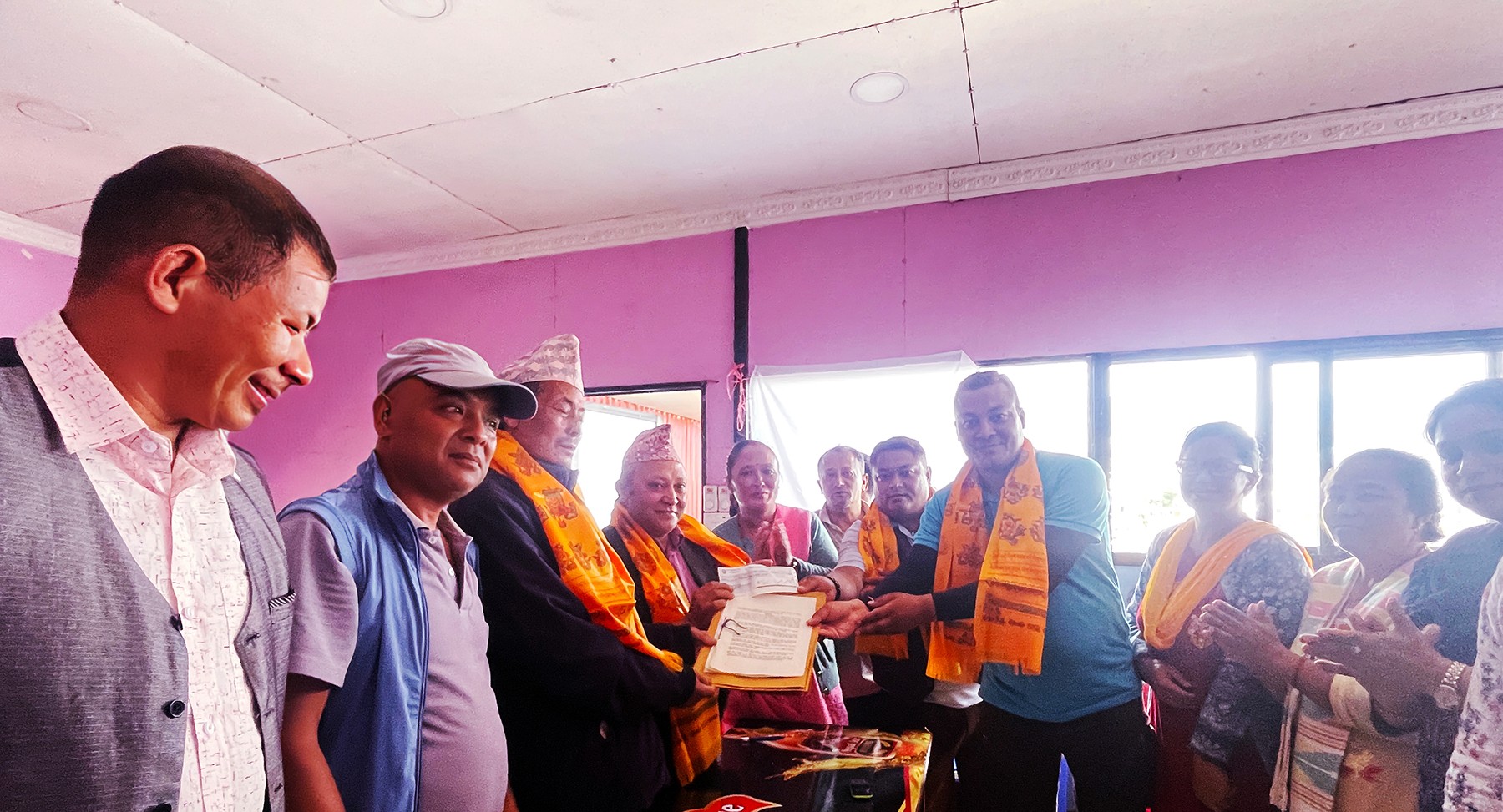
The agreement's core provisions were practical, but their significance went well beyond logistics:
- Water from the Hilegauda, Hile, Odare, and Kagate springs — sources Charikot had relied on for four decades — would flow without obstruction.
- The drinking water committee would pay NPR 30,000 annually toward the forest committee's conservation efforts, plus NPR 135,000 in outstanding arrears.
- Pipes removed during the conflict would be returned to Charikot's users at Deurali Bazaar.
It was not only a technical fix. It restored dignity to a forest committee that had felt its conservation work was going unrecognized, and it restored security to a town that had spent years worrying about its next glass of water.
Not everyone came around easily. Former forest committee chairperson Rudra Budhathoki recalls that some members objected angrily during the talks, demanding to know, "Are we going to sell water too?" But as payments began arriving reliably, that resistance eased. Today, Budhathoki notes, the funds do more than protect the springs — they also help support a local community school.
Why This Matters Beyond Dolakha
Nepal's community forestry system — among the most extensive examples of community-based natural resource management in the world — rests on the idea that local user groups can sustainably manage the forests they depend on. But as the Charikot-Suspa conflict shows, resources rarely respect institutional boundaries. A spring is at once a water source, a forest asset, and a public utility, governed by different committees with different mandates and, often, competing pressures.
Jagannath Basnet, chairperson of the Federation of Community Forestry Users, Dolakha, sees the case as a template. Conflicts like this one are becoming more common as pressure on shared natural resources grows — and local judicial bodies often lack the tools to resolve them. Structured, inclusive conflict transformation, he argues, can succeed precisely where formal institutions get stuck, because it treats the relationship — not just the resource — as the thing that needs repair. Judicial Committee Member Balkrishna Raya reflects on the experience in similar terms: “The facilitators guided the process, while the community itself reached the solution. This experience demonstrated that the process is important for transforming conflict sustainably.”
What the Water Carries Now
For nearly twenty years, the springs above Charikot were a source of division. Today, they are something closer to a shared inheritance — one that both communities have agreed, in writing and in practice, to protect together.
The water reaching Charikot's homes, schools, and hotels now carries more than relief from thirst. It carries the record of nine months of dialogue, nearly 900 participants, a nine-member spider group willing to do the patient work of listening, and two committee chairs who, after twenty years of estrangement, shook hands and meant it.
Conflict transformation, at its best, does not ask one side to win and the other to lose. It asks both sides to find the shared need underneath their competing claims — and to build something durable on top of it.
In Dolakha, the conflict transformation didn't just restore the flow of water, It restored trust.